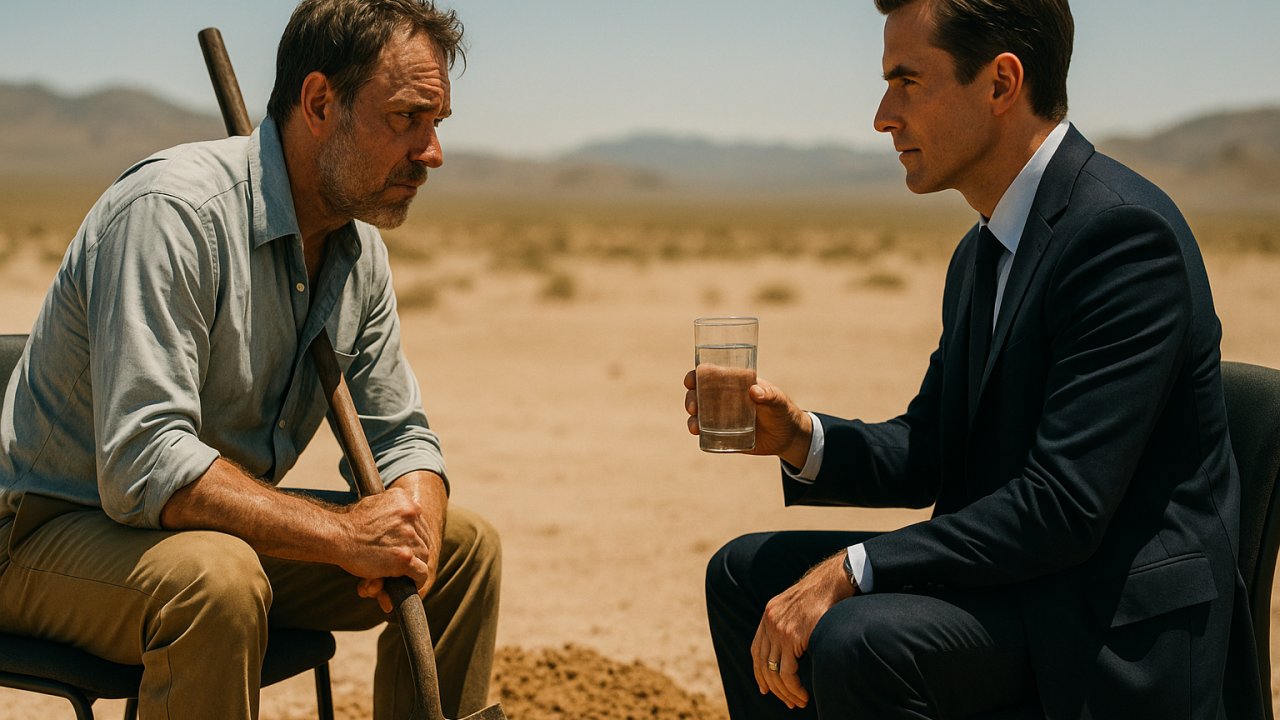
DON'T WAIT UNTIL YOU"RE THIRSY TO DIG THE WELL
Share
Why the Best Leaders Invest in Coaching Before They Need It
TL;DR: Leaders who invest in coaching proactively see 5.7x ROI and spend 3-5x less than those who wait. I increased margins 35% in 18 months through peer masterminds and 1:1 coaching—not because things were broken, but to keep them from breaking. Let me be clear: this is not a shameless article pitching you on my services. I do however believe that everyone can benefit from executive coaching, either 1:1 or mastermind groups (I have and currently participate in both). My hope is that you will read below and consider how you might benefit! Thank you for your time and enjoy!
Watch any pro golfer on the back nine.
Between shots, they're huddled with their caddy. Club selection. Green reading. Strategy.
Does Tiger Woods not know which club to use after 30 years? Of course he does. But he also knows: four eyes are better than two.
The caddy helps the player see what they can't—the wind shift, the slope, the angle that's not obvious from where you're standing.
You're already good. The question is: what are you missing that you can't see?
The Data Nobody Talks About
A Manchester Inc. study of Fortune 1000 executives showed 5.7x average ROI on coaching investments. The International Coaching Federation found 86% of companies reported ROI, with 96% saying they'd do it again.
But here's what matters more: leaders who invest proactively spend 3-5x less than those who wait until things get messy.
Stanford found that nearly 100% of CEOs valued having an outside perspective, yet less than half actually had one.
Let's call it what it is: that gap is expensive.
My Story (And Why I Waited Too Long)
When I was running a $65M operation, I had strong instincts. Good team. Solid results.
I also had blind spots I couldn't see. Because, well, they're blind spots.
Once I started working with an executive coach and joined a peer mastermind, my margins climbed 23% in 18 months. The biggest change wasn't tactics, it was having people who could see angles I was missing (and none of them were in the same industry as me!).
Here's the moment that shifted everything: my coach said, "Walk me through your calendar." Turns out, 83% of my time was reactive. Simply, I wasn't leading and focused on execution.
That one observation led to the system changes that drove those margin improvements.
I should've done it five years earlier. But I'd convinced myself I was handling it. Things were good. Why fix what's not broken?
That's the trap, by the way.
What Top Performers Already Know
Tiger Woods has multiple coaches. Eric Schmidt worked with Bill Campbell. Satya Nadella openly discusses his executive coaching.
They're not fixing problems. They're staying ahead of them.
That said, and maybe I'm not great at the sales part of this, most CEOs tell me, "Things are going really well. I don't really need a coach right now."
Part of me just nods. Because I get it. Things are good.
But here's the truth: when things are going well is exactly when you should want them to stay that way. The sands underneath? They're always shifting.
What This Isn't
This isn't therapy or hand-holding. It's someone helping you see what you can't. Someone who challenges your thinking before the market does. Think of it as "Business Therapy."
You already know this, don't you? That's why you're still reading.
Two Paths (Same 18 Months)
Path One: You kept doing what you're doing. Same blind spots. A key person left, margins compressed 8%. That departure cost you $400K and 6 months of momentum. You're not leading anymore. You're recovering.
Path Two: You spent those 18 months with people who could see what you couldn't. You tightened margins 15-35%. Built systems that scale without you. The market shifted, but you saw it coming. You're three moves ahead.
Same timeline. Different prep work. Measurably different outcomes. You're already running the numbers in your head, aren't you?
Three Questions That Matter
Can your business run for 30 days without you?
When's the last time someone on your team truly challenged your thinking on a major decision?
Am I fully engaged in my ideal lifestyle outside of work?
If you can't answer all 3 confidently, you have a gap.
What the Best Leaders Ask
Not: "Do I need this?"
But: "What's the cost of not having it?"
Because coaching isn't for the broken. It's for the committed.
Your competitors? Some of them are already doing this. They're not advertising it. They're just quietly pulling ahead.
Seeing opportunities you're missing. Building systems you haven't considered. Making moves while you're still validating.
How long are you willing to leave that advantage on the table?
Prevention is cheaper than recovery. Always.
The best time to dig a well is before you're thirsty.